
Top Latest TSC List Of Offences That Can Get Teachers Interdicted — Shocking Evidence Types Used In Disciplinary Action
TSC Updated List Of Offences & Evidence That Can Lead To Teachers Interdiction .
The Teachers Service Commission (TSC) plays a crucial role in upholding the professional standards of teachers across Kenya. One of the key disciplinary measures it employs is interdiction, which refers to the temporary suspension of a teacher from duty while investigations into alleged misconduct are carried out.
Contrary to popular belief, interdiction is not dismissal, but a process that gives a teacher the opportunity to respond to allegations before a final decision is made. However, it can ultimately lead to dismissal if the teacher is found guilty. In this article, we take a deep dive into the specific offences that can lead to TSC interdiction, the clauses they breach, and the evidence required to initiate disciplinary proceedings.
1. Immoral Behaviour and Sexual Misconduct
Among the most severe offences that lead to teacher interdiction is sexual misconduct, particularly involving learners. TSC has consistently expressed concern over the rising number of male teachers accused of engaging in inappropriate relationships or behavior with students.
Types of Immoral Behaviour That Can Lead to Interdiction:
- Engaging in sexual activity with students (carnal knowledge)
- Indecent acts or flirtation with learners
- Display or sharing of pornographic content with students
- Lesbianism, sodomy, and other sexual advances within school environments
- Inappropriate emotional relationships with learners
Breached Clauses:
Section (a)(i) to (a)(iv) of the TSC Code of Regulations for Teachers
Required Evidence:
Handwritten statements from victims and witnesses
Physical evidence such as messages, letters, photos, or exchanged gifts
Reports from school heads or sub-county directors
Board of Management (BOM) meeting minutes
Records from County Discipline Panels
Certified court documents where applicable
Teachers found guilty of such acts are not only deregistered but also included in the Sex Offenders Register, making it impossible for them to receive clearance from the DCI or secure future employment.
2. Professional Misconduct
This broad category covers a wide range of actions or omissions that reflect poorly on a teacher’s professional conduct.
A. Negligence of Duty
This occurs when a teacher fails to execute assigned tasks responsibly or deliberately avoids them.
Examples:
Skipping scheduled lessons without explanation
Failing to prepare teaching documents (e.g., schemes of work)
Ignoring Teacher on Duty roles
Assisting or ignoring cheating during examinations
Evidence Required:
Reports from school heads or County Directors
Staff meeting minutes and duty rosters
Statements from fellow teachers or students
Attendance records or class registers
B. Chronic Absenteeism
This refers to consistent absence from work without proper authorization.
Examples:
Reporting late frequently
Missing classes for several days
Ignoring school duties or failing to clock in
Supporting Documents:
Staff attendance registers
Warning or show-cause letters
Casualty returns and staff returns
C. Desertion of Duty
TSC defines desertion as being absent from duty for 14 consecutive days without written permission.
Common Triggers:
Failing to return after study leave
Ignoring transfer letters
Not reporting to a new duty station
Evidence:
Monthly staff returns
Letters from the receiving institution
Study leave approval documents
3. Insubordination
Insubordination refers to failure or refusal to follow lawful instructions issued by superiors.
Offences Include:
Ignoring official memos or directives
Refusing to report to a new duty station
Proceeding on transfer without release letters
Not submitting required institutional reports or financial books
Evidence Needed:
Reports from supervisors or County Directors
Copies of directives sent and ignored
Witness statements from school staff
Disciplinary meeting records
4. Infamous Conduct Related to Professional Integrity
Some behaviours may occur outside school but still affect a teacher’s credibility and reputation.
Examples Include:
Public drunkenness or intoxication while on duty
Fighting in public places
Gross misconduct that violates Chapter Six of the Constitution (Integrity and Ethics)
Proof Required:
Police reports or OB numbers
BOM meeting minutes discussing the incident
Medical reports (if intoxication is involved)
Witness testimonies and written reports from local authorities
5. Forgery, Fraud, and Examination Malpractice
Teachers who are caught falsifying documents or engaging in corrupt activities also face interdiction.
Common Violations:
Forged academic certificates
Altered student marks or grades
Use of fake stamps or forged staff returns
Registering unqualified individuals as teachers
Evidence Collection:
Comparison of submitted documents with records from official institutions
Expert analysis of signatures or stamps
Investigative reports from internal TSC audits
Confessions or witness accounts
6. Financial Mismanagement or Embezzlement
Teachers, especially those in administrative roles, are entrusted with managing school finances. Misuse of funds is a serious offence.
Types of Financial Misconduct:
Spending school money without approval
Unauthorized allocation of resources
Misappropriation of development funds
Proof and Documentation:
Audited financial statements
Reports from BOM meetings
Bank statements and receipts
Investigation findings from TSC or auditors
7. Criminal Convictions
If a teacher is convicted of a criminal offence, especially one that questions their moral character, they may be suspended and deregistered.
Applicable Crimes Include:
Theft, assault, or bribery
Sexual offences
Offences involving learners or other public servants
Required Proof:
Charge sheets from the courts
Certified judgments
Reports from police or prison authorities
Casualty returns from the school indicating arrest or imprisonment
Transparency and Teacher Rights During Interdiction
TSC emphasizes that teachers are entitled to fair hearing and due process. After interdiction, they are given time to respond to charges, appear before disciplinary panels, and appeal decisions if necessary.
Section 30 of the TSC Act (2012) mandates that all deregistered teachers be published publicly to safeguard learners and ensure accountability.
Final Thoughts
Maintaining ethical and professional standards within Kenya’s education sector is essential for both learners and teachers. The interdiction process, though stringent, is aimed at ensuring only those fit to teach remain in the classroom. Understanding the TSC’s list of interdiction offences and the corresponding evidence requirements can help teachers avoid pitfalls that may jeopardize their careers.
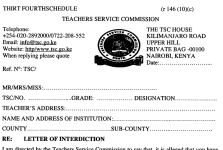
TSC Updated List Of Offences & Evidence That Can Lead To Teachers Interdiction .
Related Posts
-
 Nationwide Teachers’ Strike Looms As TSC Faces Rebellion Over 2025–2029 CBA Dispute
-
 TSC Approves Verification Exercise For The Following 3,000 Teachers: Full Details On Eligibility, Required Documents, And Timelines
-
 Confirmed ! Teachers To Receive CBA Salary Increment In July Payroll, TSC Announces
-
 Exciting News For Teachers: TSC Announces New Salary Increment Structure
About The Author
